What every enterprise learns about media intelligence from a single industry milestone.
Most mornings, business leaders wake up to dashboards full of numbers. Sales figures. Production reports. Stock prices. Operational metrics.
But outside those dashboards, another story is running.
It starts with a headline.
Last week, Adani Copper, made by Kutch Copper Limited, hit a milestone most people outside the metals world will never notice. The London Metal Exchange approved Adani Copper as a registered Grade A brand. That makes it eligible for delivery against LME copper futures contracts. To the financial world, this was a serious stamp on manufacturing quality, responsible sourcing, and global trading standards.
Here’s the part worth your attention.
The certification wasn’t the story.
The conversations it set off were.
One announcement. Hundreds of conversations.
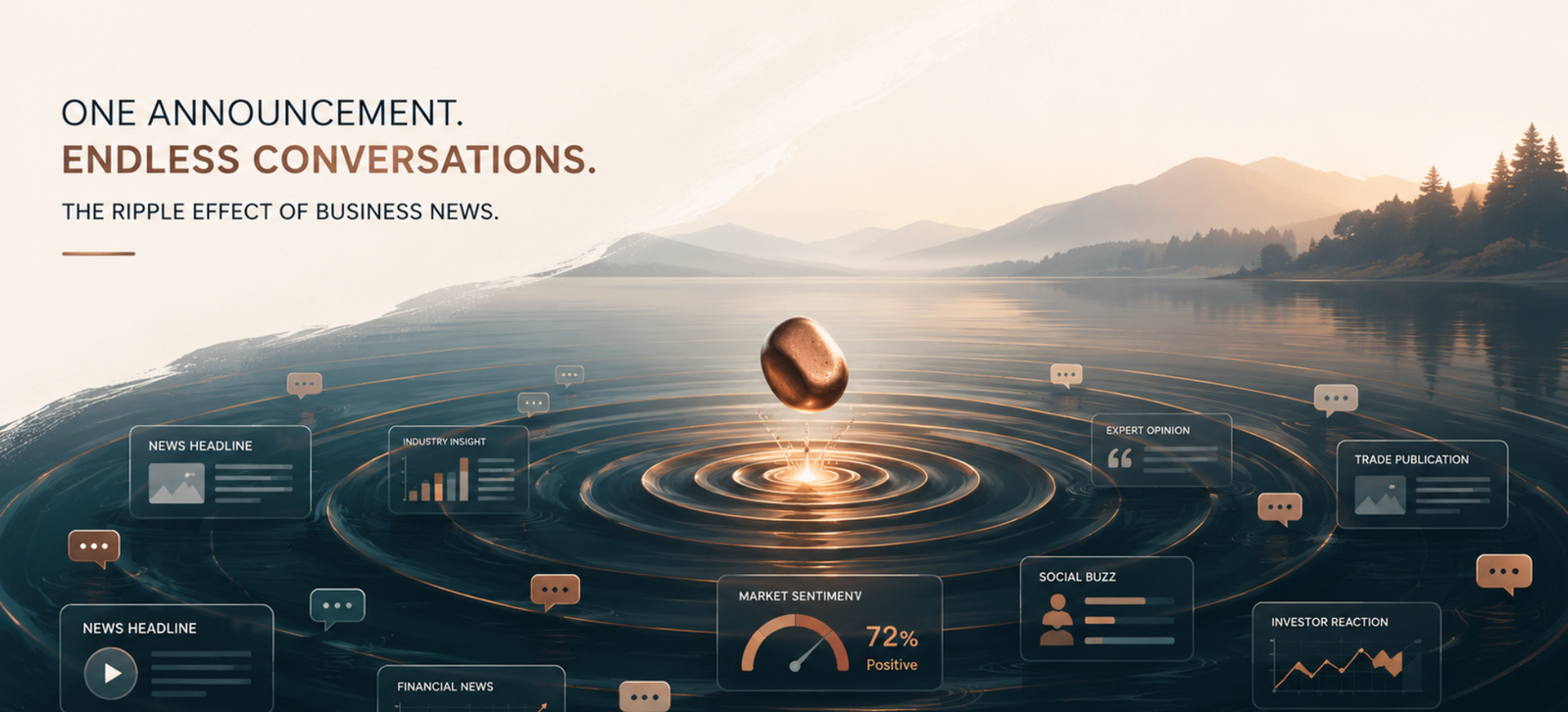
Drop a pebble into a still lake.
The splash lasts a second.
The ripples keep going long after.
Corporate news behaves the same way.
A company puts out one press release.
Within minutes, financial portals pick it up.
Industry publications read into it.
Commodity analysts weigh the implications.
Business journalists line it up against competitors.
LinkedIn adds a thousand opinions.
Market commentators turn it into videos.
Investors argue about what it means.
Before the day ends, one announcement has grown into hundreds of separate conversations. Each one hits a different audience with a slightly different spin.
No communications team follows every ripple by hand.
That’s exactly why media intelligence became a strategic need, not a reporting chore.
Beyond the press release
For decades, corporate comms chased one question.
“Did the media run our announcement?”
Today that question falls short.
Modern businesses need answers to bigger ones.
- Which publications moved investors the most?
- Was the coverage positive, neutral, or critical?
- Which regions picked up the story?
- What narratives grew after the first wave of news?
- Which competitors showed up next to your brand?
- How did social chatter differ from mainstream media?
None of these are publicity questions.
They’re perception questions.
And perception now shapes investment calls, partnerships, customer confidence, and where you sit in the market.
Why this certification mattered
To a lot of readers, “LME registration” sounds like one more technical industry update.
It’s bigger than that.
The London Metal Exchange is one of the world’s leading marketplaces for industrial metals. Winning LME brand registration puts a producer’s copper next to globally recognised brands that clear strict quality and responsible sourcing standards. It opens the door to delivery against LME copper contracts.
That one achievement pushed the conversation past manufacturing.
It became a story about India’s rising industrial muscle. Global supply chain strength. Responsible sourcing. Manufacturing excellence. Commodity markets. International trade. Future infrastructure demand.
The certification didn’t create one piece of visibility.
It created many narratives, each one built for a different audience.
Monitoring versus intelligence
Plenty of companies already watch their media coverage.
They get email alerts.
They count articles.
They save screenshots.
They build a weekly report.
Useful. But it dodges the one question that matters.
So what?
Media intelligence goes further.
Instead of counting headlines, it finds patterns.
Instead of measuring volume, it weighs influence.
Instead of collecting mentions, it surfaces the narratives forming underneath.
The point isn’t knowing what got published.
The point is knowing what the market is starting to believe.
Picture the boardroom
Now sit in a leadership meeting the morning after a big announcement.
One executive says, “We got 420 media mentions.”
Another nods. “Great.”
Then someone asks, “Were investors more optimistic after those articles?”
Silence.
Another question. “Which publications shaped the conversation?”
Silence again.
“What worries kept showing up across analysts, customers, and industry experts?”
Without structured media intelligence, those answers stay buried inside thousands of articles, interviews, broadcasts, and online threads.
The data exists.
The insight doesn’t.
Turning noise into decisions
This is where Media Analysis Process Optimisation (MAPO) flips the equation.
Instead of analysts burning hours collecting articles, killing duplicates, sorting stories, and building spreadsheets, automation handles the repeat work.
That frees analysts for the part that counts:
- spotting trends,
- reading sentiment,
- benchmarking competitors,
- tracking share of voice,
- and giving recommendations someone can act on.
The result isn’t a faster report.
It’s a better business call.
When headlines become business intelligence
Every company makes headlines.
Some launch products.
Some announce acquisitions.
Some enter new markets.
Some land certifications, partnerships, or regulatory approvals.
Each one sets off conversations that move customers, investors, employees, and industry watchers.
The hard part isn’t making news.
The hard part is understanding its impact.
Platforms like MTracker were built to close that gap.
Instead of treating news articles, TV coverage, digital publications, and social chatter as disconnected scraps, MTracker turns them into structured media intelligence. It reads sentiment, spots emerging narratives, measures share of voice, and pulls everything into executive-ready dashboards. So organisations move from watching media activity to understanding what it means for the business.
The real lesson
Adani Copper’s LME registration wasn’t only a certification.
It became a live example of how one business milestone travels across industries, countries, and audiences inside a few hours.
Every article added context.
Every analyst added interpretation.
Every conversation shaped perception.
For companies working in today’s always-on world, reputation no longer gets built through advertising or press releases alone.
It gets built through thousands of conversations running at the same time across newsrooms, financial markets, digital platforms, and industry communities.
The companies that win won’t be the ones making the most headlines.
They’ll be the ones who understand what those headlines are actually saying.
Visibility is valuable.
But understanding the story behind that visibility is where the real edge begins.

Leave a Reply