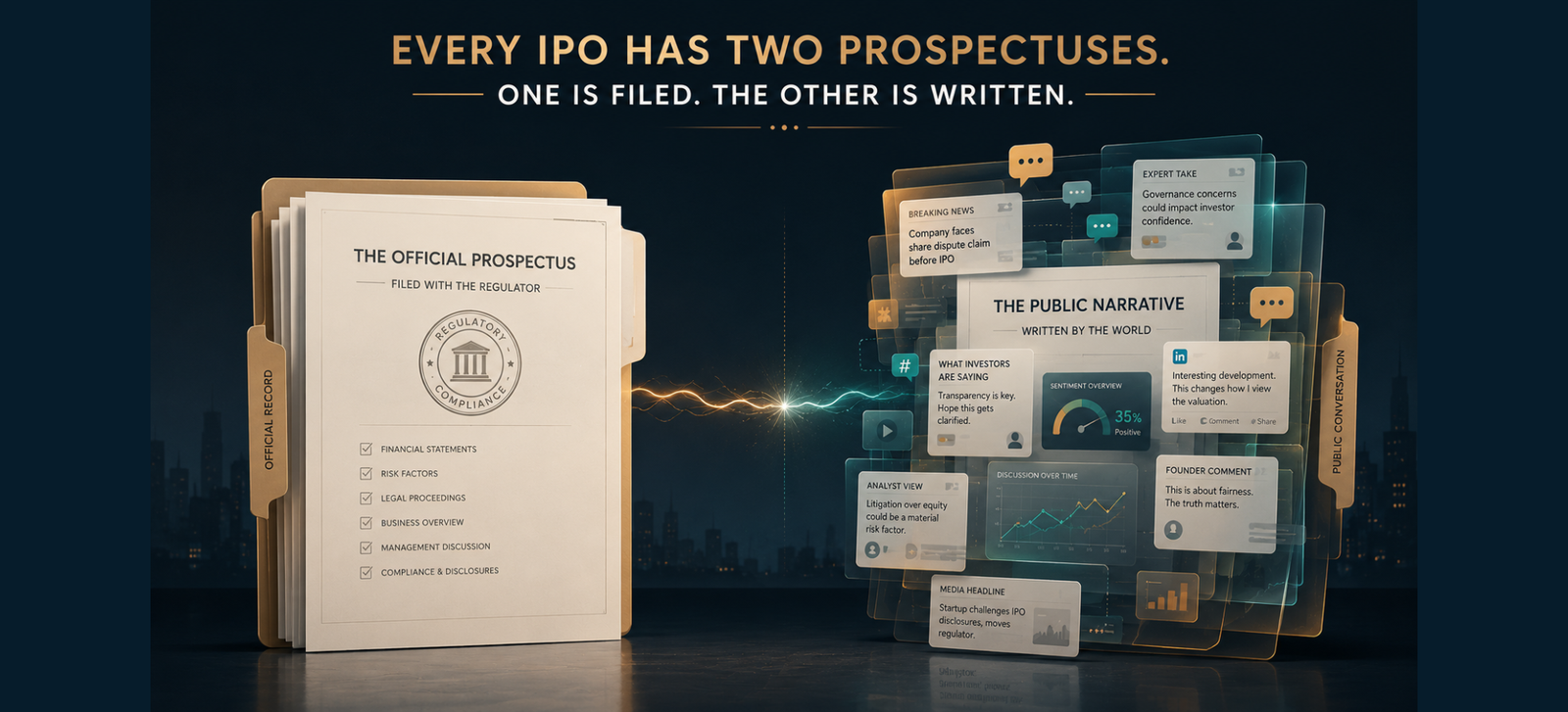
What the OYO–Zostel dispute teaches us about Media Intelligence in the age of public narratives.
Picture two investors in two different cities.
Both get the same IPO prospectus.
The first spends the evening reading hundreds of pages. Financial disclosures. Risk factors. Legal proceedings. Growth projections.
The second doesn’t open the document at all.
Instead they read a dozen business headlines, scroll LinkedIn, watch a YouTube breakdown, and skim comments from founders and finance folks.
By the end of the night, both have an opinion.
One opinion came from the prospectus.
The other came from the noise around it.
Welcome to modern capital markets, where perception moves faster than paperwork.
Recently Zostel reportedly went to SEBI asking for a review of Prism, the parent company of OYO, and its updated ₹6,650 crore IPO prospectus. Zostel argued the filing left out material information tied to a long-running dispute over a claimed 7% equity stake. Whether those claims get accepted or rejected sits with regulators and the legal process. What nobody argues is how fast the issue spread across business media, legal commentary, investor forums, and social feeds.
And that’s where the interesting question starts.
How does one legal communication turn into thousands of public conversations?
The second prospectus
Every company heading for an IPO spends months, sometimes years, building the official prospectus.
Lawyers comb every paragraph.
Auditors check the financials.
Bankers polish the story.
Regulators inspect the disclosures.
The result is a careful document built to inform investors.
But there’s a second prospectus no company writes.
It gets built by everyone else.
By journalists. By analysts. By industry experts. By customers. By investors. By influencers. By people posting on LinkedIn over coffee. By podcasts picking apart the startup ecosystem.
Unlike the official filing, this second prospectus never stops changing.
Every headline edits it.
Every opinion expands it.
Every social post reshapes it.
And often this living version is the first thing people meet, long before they read a single page of the real document.
One filing. Hundreds of interpretations.
Stand in a large hall where someone whispers a single sentence.
As it passes person to person, it shifts a little each time.
Not because anyone means to mislead.
Because everyone adds context, emphasis, and their own read.
Business news works the same way.
A regulatory filing becomes a news article.
The article becomes an analyst’s opinion.
The opinion becomes a TV debate.
The debate becomes a LinkedIn post.
The post becomes a YouTube discussion.
Soon a formal filing has grown into a whole ecosystem of narratives.
Some focus on governance.
Some dig into legal history.
Some talk startup culture.
Some guess at investor confidence.
Each audience sees the same event through a different lens.
The courtroom beyond the courtroom
Every legal dispute has two arenas.
The first is the courtroom. Evidence gets presented. Arguments get tested. Judgments come through due process.
The second arena sits outside the courtroom.
It’s the court of public opinion.
Here, headlines become opening statements.
Commentary becomes cross-examination.
Public perception becomes the jury.
While regulators and courts decide the legal outcome, a business still has to understand how the story is landing with everyone watching.
For a company approaching an IPO, that read is as valuable as tracking financial metrics.
Why headlines matter before markets open
When a company gets ready to go public, attention swells fast.
Investors want confidence.
Customers want trust.
Employees want stability.
Partners want reassurance.
Media wants a story.
Every announcement, whether it’s expansion, litigation, compliance, leadership changes, or partnerships, adds another layer to the public narrative.
The hard part isn’t tracking how much coverage there is.
It’s reading the direction of the conversation.
Is sentiment lifting?
Which topics own the discussion?
Which publications shape the opinion?
Are investors locked on growth, governance, innovation, or risk?
Counting articles won’t answer any of that.
From media monitoring to media intelligence
For years, companies measured success with simple questions.
How many articles mentioned us?
How many TV clips featured our spokesperson?
How many outlets carried our press release?
Those numbers still help.
But they don’t tell the whole story anymore.
Modern organisations need a deeper read.
They need to catch emerging themes before those themes go mainstream.
They need to see how different stakeholder groups react to the same news.
They need to track how sentiment shifts over time.
They need to compare how competitors get discussed during similar events.
This is where media intelligence pulls ahead of plain monitoring.
It turns huge piles of information into business insight you can use.
Turning conversations into strategic insight
This is exactly where Media Analysis Process Optimisation (MAPO) and Media Intelligence Process Optimisation (MIPO) become strategic muscle.
Instead of manually collecting articles, killing duplicates, sorting coverage, and stitching reports together, organisations streamline the whole intelligence process.
More important, they move past reporting activity and start reading impact.
Platforms like MTracker were built for this shift.
Instead of dumping isolated mentions on you, MTracker reads sentiment, spots emerging narratives, benchmarks share of voice, flags influential sources, and turns scattered media chatter into structured intelligence for communications teams, executives, and decision-makers.
The goal isn’t knowing what got said.
It’s understanding what it means.
Looking beyond the headlines
The OYO–Zostel matter will run its regulatory and legal course. Its outcome gets decided through established process.
But whatever the final call, it already hands every business a lesson before public scrutiny even begins.
Markets no longer react to financial performance alone.
They react to stories.
Reputation gets built across thousands of conversations running at the same time in boardrooms, newsrooms, social feeds, analyst reports, and investor threads.
Every headline adds another sentence to a company’s public narrative.
The companies that win won’t just monitor those headlines.
They’ll understand them, measure them, and act on the intelligence hiding inside them.
Because in today’s information economy, every IPO has two prospectuses.
One gets filed with the regulator.
The other gets written every day by the world watching.

Leave a Reply